
In the dynamic world of software development, where lines of code come to life and digital innovations shape our reality, there exists an unsung hero that often remains hidden in the shadows – Documentation. While the allure of writing code and designing user interfaces steals the spotlight, the power of comprehensive and well-maintained documentation quietly underpins every success story. From programmers crafting intricate algorithms to quality assurance engineers meticulously testing applications, and project managers orchestrating the symphony of teamwork, documentation stands as the common thread that weaves together the efforts of diverse roles within a software team. In this blog, we take on a journey to explore the multifaceted relevance of documentation across all roles in a software development team.
Documentation serves as a repository of collective wisdom, preserving decisions, strategies, and insights that allow team members to understand, refine, and build upon the work of others. As a result, cross-functional teams are empowered to collaborate seamlessly, fostering a fertile ground for innovation to flourish. Through comprehensive documentation, the unique strengths of each team member converge, creating a holistic and harmonious development process that is both efficient and effective.
Different types of documentation
Documents that are typically encountered in a working environment on a daily basis, but not limited to the below picture.

Yet, amid the hustle and bustle of deadlines and ever-evolving project landscapes, the task of documentation often finds itself relegated to the back burner. Several reasons contribute to this phenomenon. The lack of immediate, tangible results from documentation efforts can inadvertently lead to its de-prioritization. When compared to the immediate satisfaction of resolving a complex coding issue or delivering a feature, the long-term benefits of well-documented processes and decisions can fade into the background. Furthermore, the ever-changing nature of requirements and technologies can render documentation obsolete quickly, causing teams to question the value of investing time in recording information that may soon become irrelevant. In this whirlwind of challenges and priorities, the act of maintaining documentation can become a daunting task, often falling prey to the temptation of short-term gains.
Phases and its effect on documentation
After working for multiple teams for more than a decade and a half, I have observed a pattern across teams energy and enthusiasm towards documentation.
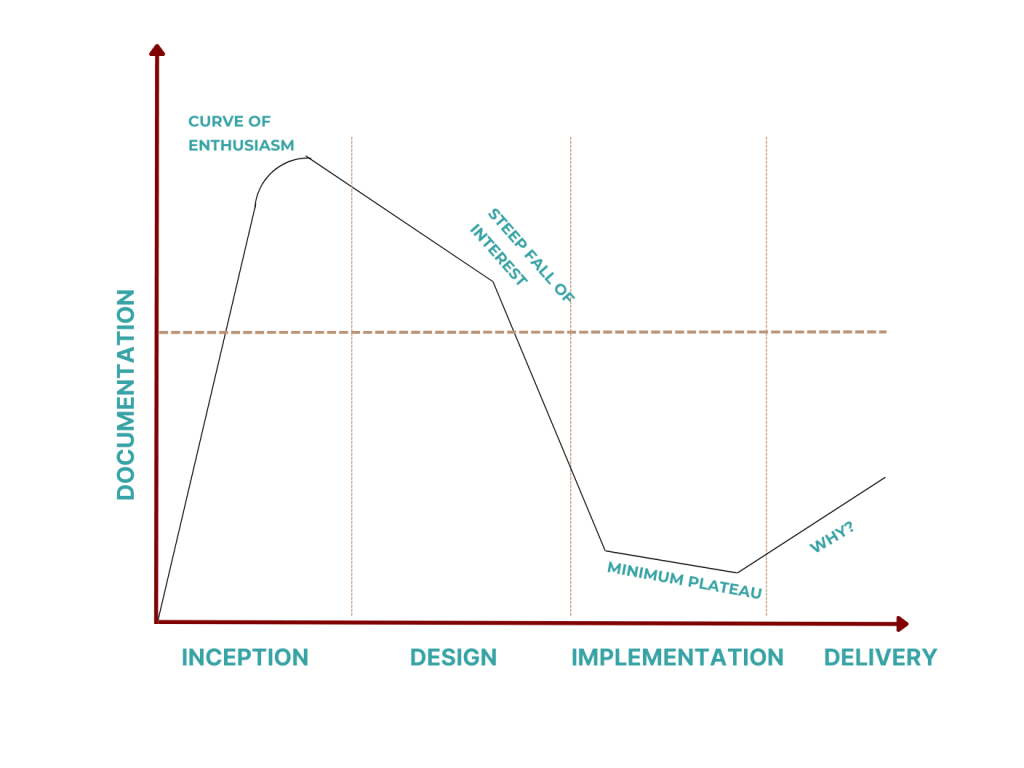
The inception phase is met with a ton of enthusiasm, incredible energy, and a total obsession with documenting everything. The recognition of the crucial role it plays in determining the success of the overall project motivates the inception phase. In this phase, the team discusses various project-related issues, for instance,
- Vision
- Stakeholders and alignment process
- Resource planning
- Identified/ assumed risk
- Measurable indicators to track progress
- Skill matrix and learning modules etc
In truth, the foundation for every project’s success is a passionate interest in and support for documentation. Members of the team begin to place more emphasis on the earliest stages of design and implementation techniques as the team moves closer to reaching clarity and the curve of enthusiasm progressively begins to dwindle.
Despite this, the importance of documentation is still highly valued even though it gradually becomes less important as a project moves from its inception to its design phase. Teams aim to capture pertinent information during the design process to keep interested parties informed and to provide transparency. To test the waters, teams debate starting with tiny implementations once the plans begin to come together. As team members find executing the proposed designs more intriguing than keeping ongoing implementation notes, we notice a sharp decline in interest in documenting anything.
Unless documentation is defined as a checkbox in a list of deliverables, motivation to maintain any kind of documentation reaches an all-time low during the implementation phase. Even under that scenario, the team grudgingly maintains the barest amount of documents to complete the criteria. Programming and testing are tasks performed during the implementation phase. As test engineering teams attempt to document application functionality as a part of test cases or confluence pages, documentation reaches a plateau
Nearing the completion of the project, we can see that interest is growing in the conversations surrounding the documentation. Stakeholders and middle management are frantically trying to tie the pieces together to create a concrete history that would inspire release confidence.
Classic 3 layers
How can managers tackle this situation?
Well, observation and data gathering are the first steps in everything. Although there is a documentation problem in every team, the causes vary depending on the team’s size, the complexity of the solution, the team’s maturity, cultural considerations, etc. Team managers should devote a significant amount of time to carefully evaluating which layer is the actual reason for this decreased motivation and come up with creative solutions.
Below picture addresses the classic 3 layers- people, process and technology, followed by some tips about handling the situation.

Hope you had a good read, if you or your team have handled the classic documentation problem in any creative way please leave a comment below.
 someooow